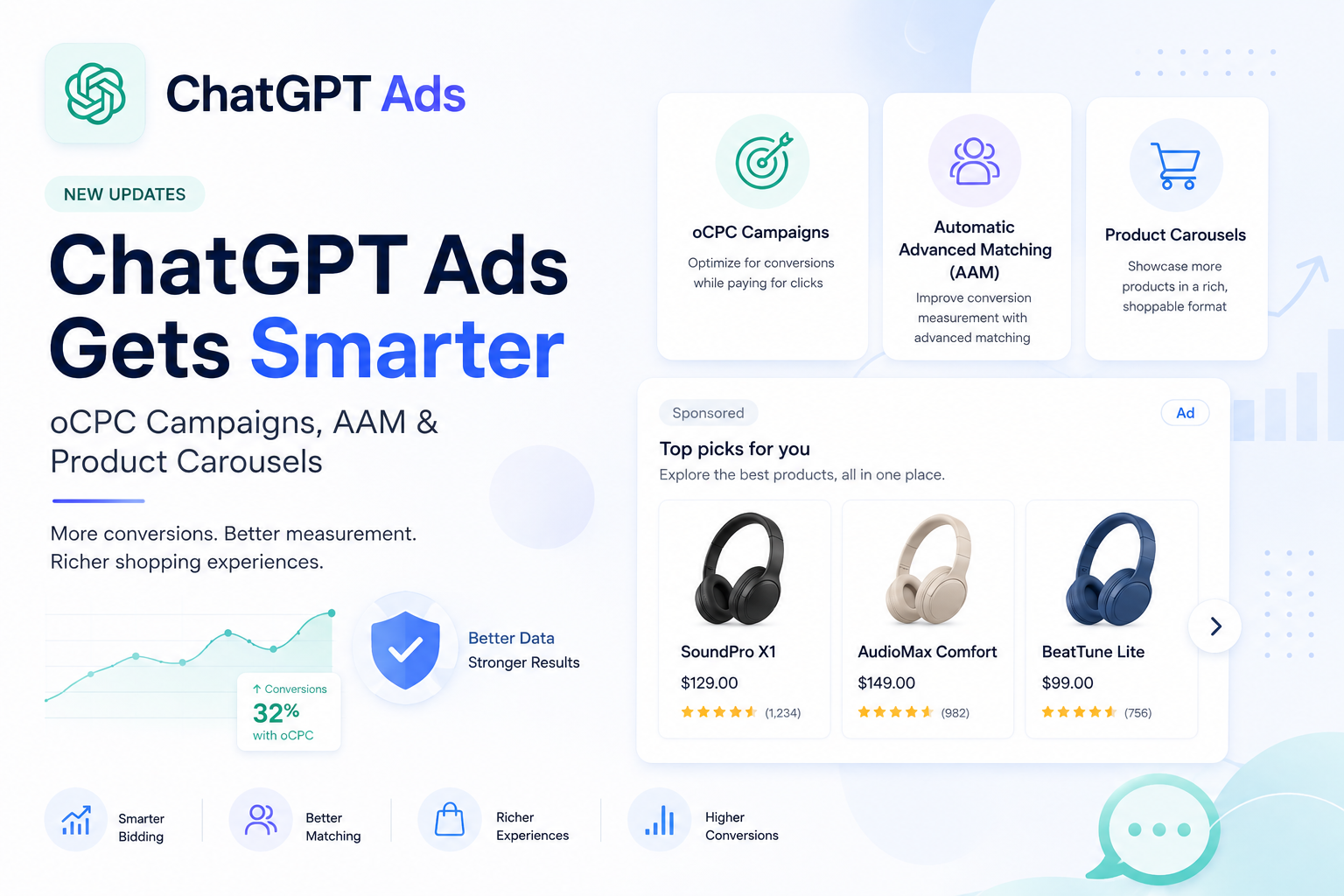
ChatGPT Ads Gets Smarter: What oCPC, AAM and Product Carousels Mean for Marketers
Quick Highlights
ChatGPT Ads is expanding beyond basic traffic campaigns toward conversion-focused advertising.
oCPC can optimize delivery toward clicks that are more likely to result in a selected conversion.
Automatic Advanced Matching (AAM) is designed to improve conversion measurement and matching.
Product-focused ad experiences can give advertisers more ways to showcase products within a conversational experience.
These changes make ChatGPT more relevant to performance marketers, but they do not make Google Ads or Meta Ads obsolete.
ChatGPT Ads Is Entering a More Performance-Focused Phase
Advertising inside an AI assistant is becoming more sophisticated. Early ChatGPT advertising conversations focused mainly on whether ads could appear naturally alongside relevant user conversations. The next stage is much more familiar to performance marketers: better conversion optimization, stronger measurement and richer commerce experiences.
The latest ChatGPT Ads developments include optimized cost-per-click (oCPC), Automatic Advanced Matching (AAM), and product-focused advertising experiences. Together, they point toward a platform that is trying to understand not only whether someone clicks an advertisement, but whether that interaction contributes to a meaningful business outcome.
What Is oCPC in ChatGPT Ads?
oCPC stands for optimized cost-per-click. A conventional CPC campaign is primarily concerned with generating clicks. An oCPC campaign can use conversion signals to help prioritize clicks that are more likely to lead to a selected conversion.
The advertiser still pays for valid clicks rather than paying directly for completed conversions. The important difference is the optimization objective: instead of treating every click as equally valuable, the system can use downstream conversion information to improve delivery.
Why oCPC Matters to Performance Marketers
Consider an online retailer that receives 1,000 clicks from an advertising campaign. A traffic-focused campaign can generate those visits, but the business ultimately cares about purchases. Some visitors may browse and leave, while others may buy. Conversion-focused bidding attempts to learn from those differences and find more traffic that resembles users who completed the desired action.
What Is Automatic Advanced Matching (AAM)?
Automatic Advanced Matching is primarily a measurement feature. The challenge is connecting an advertising interaction with a later website conversion when the conversion does not happen in the same session or in a perfectly identifiable path.
AAM can help improve the matching of conversion activity with advertising interactions using appropriately handled customer information. The practical objective is to improve the quality of the conversion signal available to advertisers.
Why oCPC and AAM Work Well Together
The two features address different parts of the same performance-marketing problem. oCPC focuses on optimization, while AAM focuses on measurement.
The relationship can be viewed as: Ad interaction → Website visit → Conversion → Better measurement → Stronger conversion signal → Better campaign optimization.
If conversion data is incomplete, automated bidding has less information to learn from. Better measurement therefore becomes increasingly important as advertisers adopt conversion-focused objectives.
What About Product Carousels?
Product-focused advertising introduces another important change. Instead of presenting only one product or a simple text-based advertisement, carousel-style experiences can give advertisers the opportunity to showcase multiple products in a single conversational environment.
This is especially relevant to e-commerce because customers often compare several products before deciding what to buy. Price, features, design and availability can all influence the final decision.
An Important Distinction: Product Results vs Product Ads
Advertisers should be careful with terminology. ChatGPT can show organic product results that are separate from advertising. OpenAI’s shopping documentation says product results are not ads and are selected independently.
Paid product-feed advertising is a different concept. Advertisers can provide product information for advertising purposes, while organic product discovery remains separate. A product appearing in a ChatGPT shopping experience does not automatically mean the brand paid for that placement.
Why Conversational Advertising Is Different
Traditional search advertising is strongly associated with keywords. A user types a query, the advertising system interprets it, and relevant ads can appear.
A ChatGPT conversation can contain considerably more context. A user might say, ‘I need a laptop for video editing, I travel frequently, and I have a budget of $1,500.’ That statement contains budget, use case and lifestyle information in one interaction.
For advertisers, this creates a different kind of intent signal. The opportunity is not simply matching a keyword; it is understanding the problem the user is trying to solve.
What Advertisers Should Do Now
Businesses should not move their entire paid-media budget to ChatGPT simply because these features are launching. A better approach is controlled testing.
First, make sure conversion tracking is accurate. Second, test multiple creative variations. Third, think about customer problems rather than only keyword lists. For e-commerce brands, product data should also be accurate, complete and up to date.
ChatGPT Ads vs Google Ads and Meta Ads
ChatGPT Ads should currently be viewed as an additional channel rather than a replacement for established advertising platforms.
Google Ads has enormous search intent and a mature advertising ecosystem. Meta has powerful audience, creative and social-discovery capabilities. ChatGPT’s differentiator is conversational context: users can explain their needs in natural language, potentially giving an advertising system richer information about intent.
The strategic question is not ‘Which platform will replace the others?’ but ‘Where does ChatGPT add incremental reach or intent that my existing channels do not capture?’
What These Updates Mean for Digital Marketers
The three developments can be viewed as three pieces of a larger performance-marketing system: oCPC for conversion-focused optimization, AAM for stronger conversion measurement, and product experiences for more ways to present commercial choices.
Together, they suggest that ChatGPT Ads is moving toward an advertising ecosystem built around conversation, intent and measurable outcomes.
The Bigger Opportunity: AI-Native Advertising
The long-term opportunity is not simply copying Google Ads inside ChatGPT. AI assistants can support a different advertising journey: Conversation → Recommendation → Consideration → Ad → Action.
That shift could create new advertising formats that feel more native to conversational interfaces. Product carousels may be one early example of that direction.
Final Takeaway
The rollout of oCPC, Automatic Advanced Matching and product-focused advertising shows that ChatGPT Ads is becoming more relevant to performance marketers.
The immediate priorities are straightforward: establish reliable conversion tracking, test conversion-focused bidding when sufficient data is available, create multiple relevant ad variations, maintain accurate product information and measure ChatGPT alongside existing paid channels.
The bigger change is conceptual. Advertising is moving from matching short search queries to understanding longer, richer conversations.
Key Takeaways
oCPC focuses campaign optimization on clicks more likely to produce selected conversions.
AAM is designed to strengthen conversion matching and measurement.
Product-focused ad experiences can support conversational commerce.
Organic ChatGPT product results and paid product advertising should not be treated as the same thing.
ChatGPT Ads should be tested as an additional performance channel, not automatically treated as a replacement for Google or Meta.
Reliable conversion tracking is essential before using automated conversion optimization.
Frequently Asked Questions
What is oCPC in ChatGPT Ads?
oCPC is optimized cost-per-click bidding that can use conversion signals to prioritize clicks more likely to result in a selected conversion.
What does AAM mean in ChatGPT Ads?
AAM refers to Automatic Advanced Matching, a measurement mechanism intended to improve conversion matching using appropriately handled customer information.
Are ChatGPT product results ads?
Not necessarily. OpenAI distinguishes organic product results from advertisements.
What are product carousel ads?
They are advertising experiences that can present multiple products in a conversational environment.
Should businesses move from Google Ads to ChatGPT Ads?
No. ChatGPT Ads should be evaluated as an additional channel and tested against business goals.
What is most important before running oCPC?
Accurate conversion tracking and enough reliable conversion signals for optimization.
