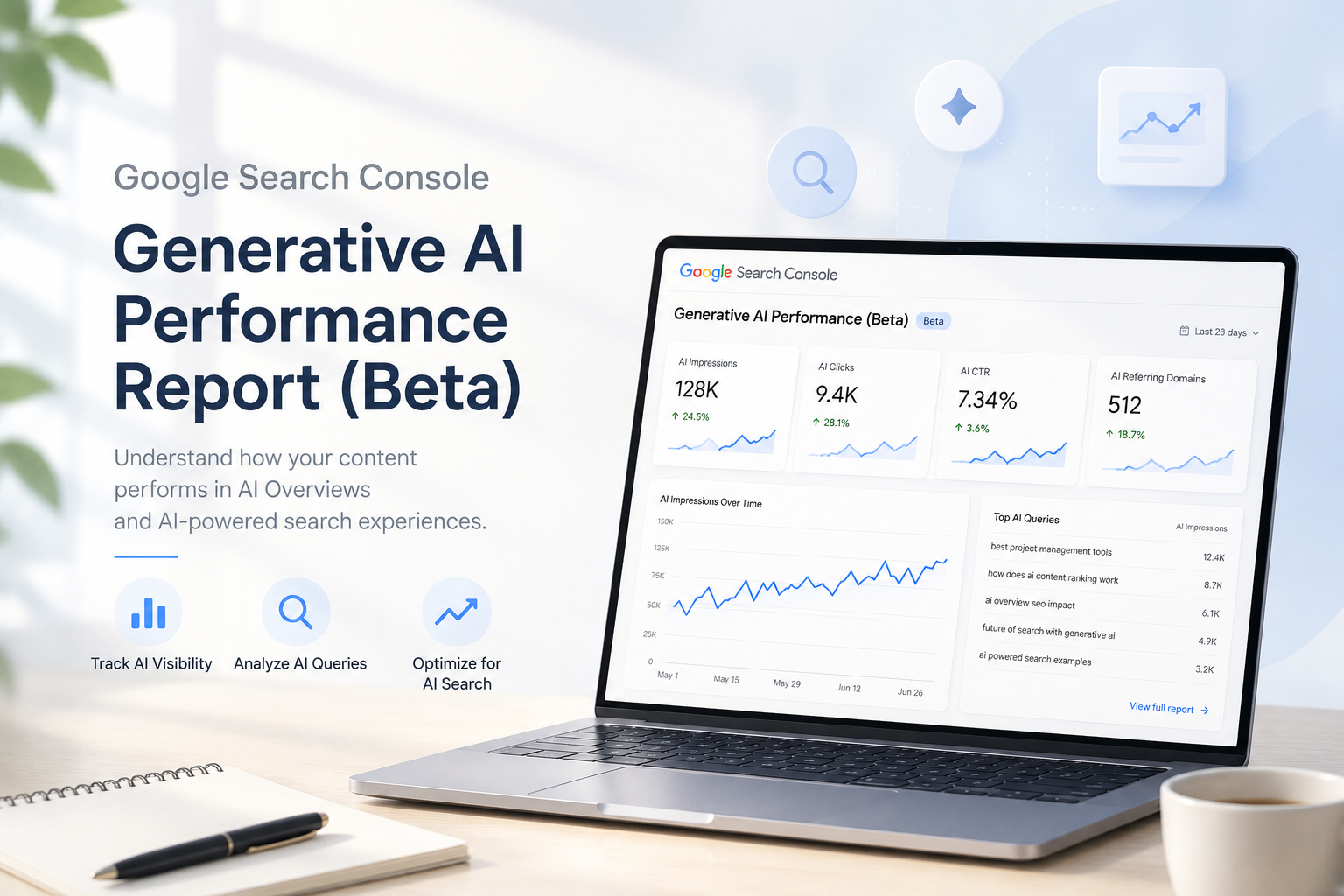
Google Search Console’s Generative AI Performance Report (Beta): What Every SEO Professional Should Know
Quick Highlights
Before diving into the details, here are the biggest takeaways:
- Google has introduced the Generative AI Performance Report in Search Console (Beta).
- It helps website owners understand how often their content appears in Google’s AI-powered search experiences.
- This is one of the first official steps toward measuring AI visibility, not just traditional organic rankings.
- Helpful, original, and experience-based content remains the foundation of SEO.
- AI Optimization (GEO) complements traditional SEO—it doesn’t replace it.
Google Search Is Changing Faster Than Ever
Search has evolved dramatically over the last few years.
Instead of showing only ten blue links, Google now provides AI-generated summaries that help users find answers more quickly. These AI-powered experiences—such as AI Overviews and AI Mode—are changing how people discover information online.
For businesses, publishers, and SEO professionals, this creates an important question:
How do you know whether your website is appearing in these AI experiences?
To answer that question, Google introduced the Generative AI Performance Report inside Google Search Console.
Although it’s currently in Beta, this feature marks a significant shift in how SEO performance will be measured in the future.
What Is the Generative AI Performance Report?
The Generative AI Performance Report is a new reporting section within Google Search Console that helps website owners understand their visibility in Google’s AI-powered search experiences.
Unlike the traditional Performance report—which focuses on clicks, impressions, CTR, and average position—this report focuses on AI visibility.
Instead of asking:
“How many users clicked my page?”
Businesses can now begin asking:
“How often is my content being surfaced by Google’s AI?”
This is an important change because AI search is becoming a major discovery channel for websites.
Why Did Google Introduce This Feature?
Google understands that search behaviour is changing.
Millions of users now interact with AI-generated answers before clicking websites.
Because of this change, traditional SEO metrics alone are no longer enough.
The new report helps website owners:
- Measure AI visibility
- Understand content performance in AI experiences
- Improve future content strategies
- Prepare for AI-first search
For SEO professionals, this represents the beginning of a new reporting category.
Why This Matters for SEO
For years, success was measured by rankings and organic traffic.
Today, another metric is becoming equally important:
AI Visibility
Imagine your article appears inside Google’s AI-generated response.
Even if users don’t immediately click your website, your brand gains visibility, authority, and trust.
That exposure can influence future searches and brand recognition.
Businesses that begin optimizing for AI experiences today may gain an advantage as Google’s AI search continues expanding.
Benefits of the Generative AI Performance Report
1. Understand AI Visibility
You can begin tracking how often your pages appear in Google’s AI experiences.
2. Improve Content Strategy
Identify which pages receive AI impressions and update similar content with additional value.
3. Measure GEO Performance
Generative Engine Optimization (GEO) is becoming an important extension of traditional SEO.
This report provides an early indicator of GEO success.
4. Support Better Reporting
Enterprise SEO teams can now include AI visibility alongside:
- Organic Clicks
- Organic Impressions
- Keyword Rankings
- Leads
- Conversions
Current Limitations
Since the feature is still in Beta, there are several limitations.
Currently, Google provides limited reporting compared to the traditional Search Performance report.
Some metrics are still unavailable or limited, including:
- AI Clicks
- AI CTR
- Detailed AI search queries
- Complete AI ranking information
This doesn’t reduce the report’s value—it simply means Google is continuing to develop it.
How to Improve Your AI Visibility
Many businesses think AI optimization requires an entirely new strategy.
It doesn’t.
Most of Google’s existing quality principles still apply.
Create Helpful Content
Answer real questions instead of writing only for search engines.
Demonstrate Experience
Include examples, screenshots, case studies, or personal observations whenever possible.
Build Topical Authority
Publish multiple high-quality articles around one subject instead of isolated posts.
Structure Content Clearly
Use:
- Short paragraphs
- Headings
- Bullet points
- Tables
- FAQs
Structured content is easier for both users and AI systems to understand.
Keep Information Accurate
Fact-check statistics and refer to official documentation whenever discussing Google features.
Practical Example
Imagine a digital marketing agency publishes a guide about AI SEO.
After improving the article with:
- Original screenshots
- Better headings
- Frequently Asked Questions
- Real testing results
The page begins receiving AI impressions inside Search Console.
Although rankings may remain similar initially, the increased AI visibility indicates Google considers the content valuable for AI-powered answers.
This is exactly the type of insight the new report aims to provide.
SEO Is Not Dead—It’s Expanding
Some people believe AI will replace SEO.
That’s incorrect.
AI search still depends on high-quality web content.
Without trusted websites, AI cannot generate reliable answers.
The fundamentals remain the same:
- Create useful content.
- Demonstrate expertise.
- Build trust.
- Provide original insights.
The difference is that SEO now includes AI visibility alongside traditional rankings.
Key Takeaways
- Google’s Generative AI Performance Report is an important step toward measuring AI search visibility.
- The report is currently in Beta and will likely expand over time.
- AI visibility should complement—not replace—traditional SEO metrics.
- Helpful, original, experience-based content remains the strongest long-term strategy.
- Businesses investing in quality content today will be better prepared for the future of AI-powered search.
Frequently Asked Questions
Is the Generative AI Performance Report available for every website?
No. Google is rolling it out gradually to eligible Search Console properties.
Can AI-written content rank?
Yes. Google evaluates content based on quality, originality, and usefulness—not simply on whether AI assisted with drafting.
Does GEO replace SEO?
No. GEO builds on traditional SEO by optimizing content for AI-powered search experiences.
Should I update my existing blog posts?
Yes. Refreshing high-performing articles with better structure, examples, and current information can improve their usefulness.
What should businesses monitor?
Track AI impressions together with organic traffic, conversions, keyword rankings, and user engagement.
Final Thoughts
Google Search is entering a new era where visibility extends beyond traditional rankings.
The Generative AI Performance Report gives website owners an early opportunity to understand how their content performs within AI-powered search experiences.
While the report is still evolving, one principle remains unchanged:
Create content that genuinely helps people.
Businesses that combine technical SEO, high-quality writing, topical authority, and Generative Engine Optimization will be in a stronger position as AI search continues to grow.
If your goal is long-term visibility, don’t optimize only for algorithms—optimize for people first. Google has consistently rewarded helpful content, and AI search is reinforcing that direction.
