Google AI Shopping Descriptions Explained: How to Optimize Your Merchant Center for the AI Era
Artificial Intelligence is changing nearly every aspect of Google’s search and advertising ecosystem. Over the past two years, Google has introduced AI-powered search experiences, AI Overviews, automated campaign recommendations, creative generation tools, and smarter bidding strategies.
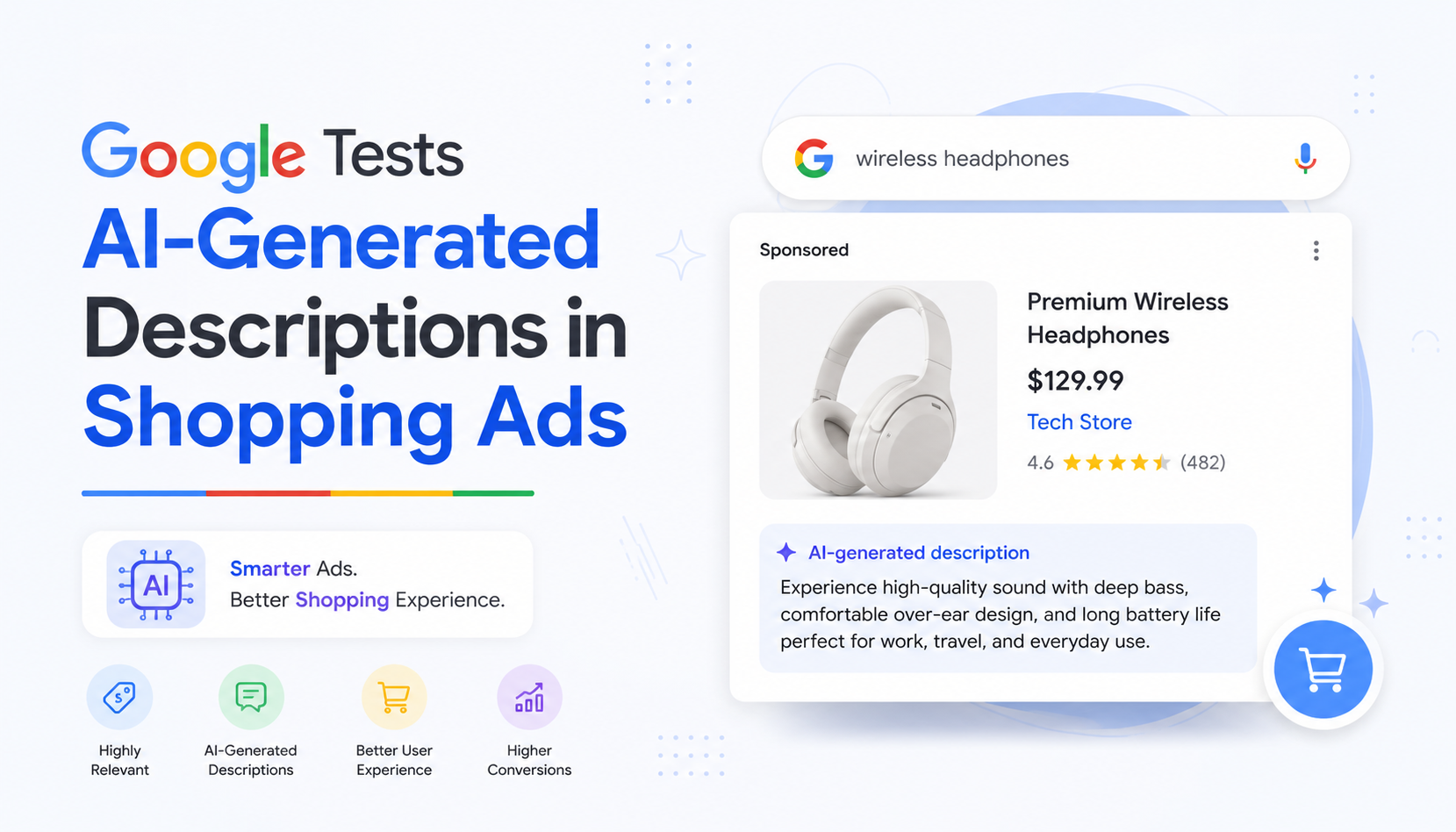
The latest development being tested is AI-generated descriptions in Google Shopping Ads.
Instead of showing only a product image, title, price, and merchant name, Google is experimenting with displaying short AI-written descriptions that help shoppers quickly understand why a product may match their search.
Although the feature is still in testing, it signals an important shift in how product information may be presented in Google Ads.
For businesses that rely on Google Shopping campaigns, preparing high-quality product data today could become a competitive advantage tomorrow.
What Are AI-Generated Descriptions in Google Shopping Ads?
Traditionally, Shopping Ads have displayed information directly supplied by the merchant, including:
- Product image
- Product title
- Price
- Brand
- Store name
- Product rating (if available)
The AI-generated description adds another layer by summarizing important product details in simple language.
Instead of simply displaying a product title, Google may provide a concise explanation highlighting features, benefits, or intended use.
For example, if someone searches for:
“waterproof hiking shoes”
An AI-generated description could explain that the shoes are designed for wet conditions, feature durable grip, and provide ankle support for outdoor activities.
The goal is to reduce uncertainty and help users make faster purchasing decisions.
Why Is Google Testing This Feature?
Google’s primary objective is to improve the shopping experience.
Modern consumers expect quick answers without opening multiple websites.
Rather than forcing users to compare several listings manually, AI can summarize relevant information directly within the Shopping Ads interface.
Potential goals include:
- Improving shopping experience
- Increasing ad relevance
- Helping users compare products faster
- Reducing confusion caused by vague product titles
- Increasing click-through rates
- Improving conversion quality
This aligns with Google’s broader strategy of making Search and Shopping more conversational and context-aware.
How AI May Generate Product Descriptions
Google’s AI is expected to rely on multiple sources of product information rather than inventing entirely new content.
Possible inputs include:
- Product title
- Product description
- Product specifications
- Merchant Center attributes
- Brand information
- Structured product data
- Category information
- Website content
The better the available information, the more useful the generated description is likely to be.
If product data is incomplete or inaccurate, AI summaries may also become less informative.
Why This Matters for Online Businesses
Many businesses invest heavily in advertising budgets while overlooking product feed quality.
Historically, advertisers focused mainly on:
- Product titles
- Product images
- Pricing
As AI becomes more involved in presenting product information, detailed descriptions and structured attributes are likely to play a bigger role.
Businesses with complete and accurate product data may have an advantage over competitors with poorly maintained feeds.
The Growing Importance of Merchant Center Optimization
Merchant Center has always been important for Shopping campaigns.
However, AI-powered Shopping experiences increase the importance of maintaining clean, structured, and complete product information.
Businesses should regularly review:
- Product titles
- Descriptions
- Brand names
- GTIN numbers
- Product categories
- Material
- Color
- Size
- Availability
- Pricing
- Images
Missing information can reduce both ad quality and the usefulness of AI-generated summaries.
Potential Benefits of AI-Generated Shopping Descriptions
Better User Experience
Customers receive additional product context before clicking.
This helps reduce uncertainty during the buying process.
More Relevant Traffic
When users better understand a product before visiting the website, clicks may be more qualified.
That can lead to improved conversion quality.
Faster Purchase Decisions
Instead of comparing multiple websites, shoppers can gather essential information directly from Shopping Ads.
Improved Product Discovery
AI summaries may help surface relevant product features that shoppers did not specifically search for.
Challenges Businesses Should Consider
Like every AI-powered feature, there are potential limitations.
Reduced Messaging Control
Businesses may not control every word shown in AI-generated descriptions.
Dependence on Product Data
Poor-quality product feeds can produce weaker summaries.
Competitive Similarity
If multiple merchants provide identical manufacturer descriptions, AI-generated summaries may become similar across advertisers.
This makes original product content increasingly valuable.
How Businesses Should Prepare
Businesses should focus on strengthening their product data instead of waiting for the feature to become widely available.
Recommended actions include:
Write Better Product Titles
Avoid keyword stuffing.
Use descriptive titles that naturally include:
- Brand
- Product type
- Model
- Important feature
- Size or variation
Improve Product Descriptions
Instead of writing generic content, explain:
- Primary purpose
- Key benefits
- Important specifications
- Materials
- Ideal users
- Common use cases
Complete Product Attributes
Fill every applicable attribute inside Merchant Center.
Structured information helps Google’s systems better understand products.
Use High-Quality Images
Images remain one of the strongest elements influencing Shopping Ads.
Use clear, professional product photography.
Keep Product Information Updated
Prices, availability, specifications, and descriptions should always reflect the current product.
What This Means for SEO
Although Shopping Ads are paid placements, the underlying principle also supports modern SEO.
Google increasingly rewards content that is:
- Helpful
- Well structured
- Accurate
- Context-rich
- Easy to understand
Whether someone discovers your business through Shopping, Search, or AI-powered experiences, detailed product information improves visibility and user trust.
Impact on AI Search
Generative AI systems rely on high-quality information.
Businesses that publish detailed product pages, structured specifications, helpful FAQs, and original content are more likely to be understood accurately by AI-powered search experiences.
This means product optimization is becoming valuable beyond traditional Shopping campaigns.
Best Practices Checklist
Before running Shopping campaigns, ensure that you have:
✔ Descriptive product titles
✔ Original product descriptions
✔ Complete product attributes
✔ Accurate pricing
✔ Updated availability
✔ High-resolution images
✔ Correct brand information
✔ Product identifiers
✔ Mobile-friendly landing pages
✔ Fast website loading speed
✔ Clear product specifications
✔ Helpful customer information
Frequently Asked Questions
Is this feature available to everyone?
Google is testing AI-generated Shopping descriptions with selected advertisers. Availability may expand over time.
Can businesses write the AI description themselves?
Businesses control their product data, but Google may generate summaries based on that information.
Does this affect SEO?
Not directly, but improving product content benefits both Shopping campaigns and organic search visibility.
Should businesses update existing product descriptions?
Yes. High-quality, original product descriptions help both users and Google’s systems better understand your products.
Will AI replace traditional Shopping Ads?
No. AI is designed to enhance Shopping Ads rather than replace them.
Final Thoughts
Google’s experimentation with AI-generated descriptions in Shopping Ads represents another step toward more intelligent advertising experiences.
While the feature is still evolving, the direction is clear: high-quality product information is becoming increasingly important.
Businesses that invest in accurate Merchant Center feeds, detailed product pages, structured data, and user-focused content are likely to be better prepared for the future of AI-powered search and digital advertising.
Instead of viewing AI as a replacement for marketing strategy, businesses should treat it as a tool that rewards clear, complete, and trustworthy information.
As Google’s advertising ecosystem continues to evolve, the companies that prioritize content quality, structured data, and customer experience will be in the strongest position to adapt.
